While Large Language Models (LLMs) continue to shatter benchmarks in software engineering, mathematics, and code generation, the landscape of AI for Science (AI4S) tells a more nuanced story. In domains like fluid dynamics, molecular biology, and materials science, progress isn’t just about scaling parameter sizes or throwing more compute at text tokens.
To unpack the current bottlenecks, paradigm shifts, and future trajectories of AI4S, the following multi-turn Q&A captures the core insights from discussions on why some domains achieve rapid automated breakthroughs while others face rigid physical walls.
Q: Why do tasks like mathematical proof generation and code debugging scale so well with LLMs, while physical sciences progress differently?
The core differentiator boils down to verification cost and feedback bandwidth. In mathematics, we rely on formal verification systems (like Lean) or strict logical proofs. In software engineering, code can be executed instantly against test suites, compilers, and benchmarks. Because the verification loop is extremely fast and low-cost, models can leverage scale-out search—generating thousands of candidate solutions, exploring high-cost branches, and automatically filtering out failures.
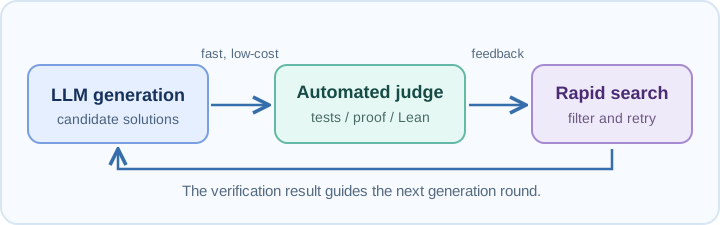
However, real-world physical science doesn’t have a “Lean-style automatic verifier” for most hypotheses. If an AI model proposes a novel physical mechanism, a new turbulence closure model, or a custom source term for the Navier-Stokes equations, validating it often requires a physical experiment, an expensive observational campaign, or long-running high-fidelity simulations. As noted in the discussions: “We cannot simply build 100,000 virtual Earths or run millions of wet-lab experiments overnight.” The bottleneck of AI4S isn’t just generating hypotheses; it’s the scarcity of high-bandwidth scientific feedback.
Q: Let’s talk about recent high-profile mathematical and physical breakthroughs, such as AI tackling complex fluid dynamics (like Navier-Stokes structures). How should engineers view these results?
We need to strictly separate mathematical significance from immediate engineering applicability.
- The Mathematical Value: Working on things like the existence, smoothness, or blow-up structures of PDEs is monumental for pure mathematics. These constructions often reveal deep underlying mechanisms regarding how multi-scale vortex structures interact, or help establish rigorous upper bounds for energy spectra.
- The Engineering Reality: These theoretical constructions often rely on very specific forcing families and idealized scaling conditions. When you push them down to microscopic physical scales, issues of physical realizability and the breakdown of continuum mechanics kick in.
In short, while these breakthroughs expand the upper boundary of what AI can assist with in theoretical math, their direct deployment in industrial CFD (Computational Fluid Dynamics) requires rigorous scale analysis, physical modeling, and real-world realizability checks.
(Background Note: Similar trends are evident in biological foundation models like AlphaFold 3 and ESM-3, which can instantly predict protein structures or design novel enzymes in silico, but still require rigorous wet-lab validation to confirm cellular viability and binding kinetics.)
Q: Given that scientific data is messy, multi-scale, and heterogeneous, how are researchers tackling the data bottleneck in AI4S? Is the “small model” trend here to stay?
Many successful AI4S applications still rely on relatively small or mid-sized models rather than trillion-parameter LLMs. This is primarily a constraint of data availability and representation formats, not a failure of scaling laws.
Unlike the internet, which provides endless text tokens, high-fidelity physical data is bounded by experimental throughput, sensor deployment, and grid-resolution limits. Furthermore, physical fields, molecular graphs, spectral data, and mesh structures don’t map cleanly into standard text tokens.
However, looking at success stories like ERA5 (the global reanalysis dataset by ECMWF) or large-scale weather prediction models (like Google’s GraphCast or Huawei’s Pangu-Weather), we see what truly works: data integration. ERA5 succeeds because it harmonizes billions of sparse observations, physical constraints, and data assimilation pipelines into a unified, high-quality asset.
When data is scarce, increasing model size alone yields diminishing returns. In these regimes, investing in data quality, physical consistency, diversity, and cross-modal simulation-observation fusion is far more critical. “Small model AI4S” is an engineering compromise for today’s data scarcity, not proof that scientific models won’t scale in the future.
Q: Looking toward future advanced reasoning systems (like GPT-6 tier models), how will AI transition from a passive predictor to an active “AI Researcher” or Agent?
The field is rapidly shifting from passive prediction to active system loops via AI Agents.
If we look at how human simulation engineers work, they don’t just run a black-box model. They rely heavily on modeling experience—knowing when to simplify a geometry, which boundary conditions to drop, how to interpret numerical anomalies, and how to tune parameters based on past project failures. Much of this valuable engineering knowledge is currently trapped in legacy codebases, technical reports, and senior experts’ tacit knowledge.
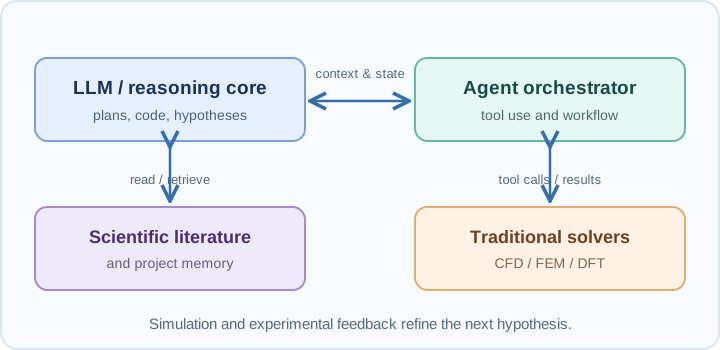
Future systems—whether powered by next-generation reasoning architectures or specialized domain agents—will operate as comprehensive AI Researchers:
- Reading & Planning: Reviewing existing literature and defining new source terms or governing equations.
- Execution & Tool Use: Interacting with traditional scientific software (FEM, CFD, DFT solvers) as deterministic calculation engines while the LLM handles workflow planning and reasoning.
- Iterative Review & Correction: Analyzing simulation or experimental feedback, modifying numerical setups, and refining hypotheses in a closed loop.
Q: To wrap things up, how can we summarize the ultimate roadmap and key takeaway for AI4S?
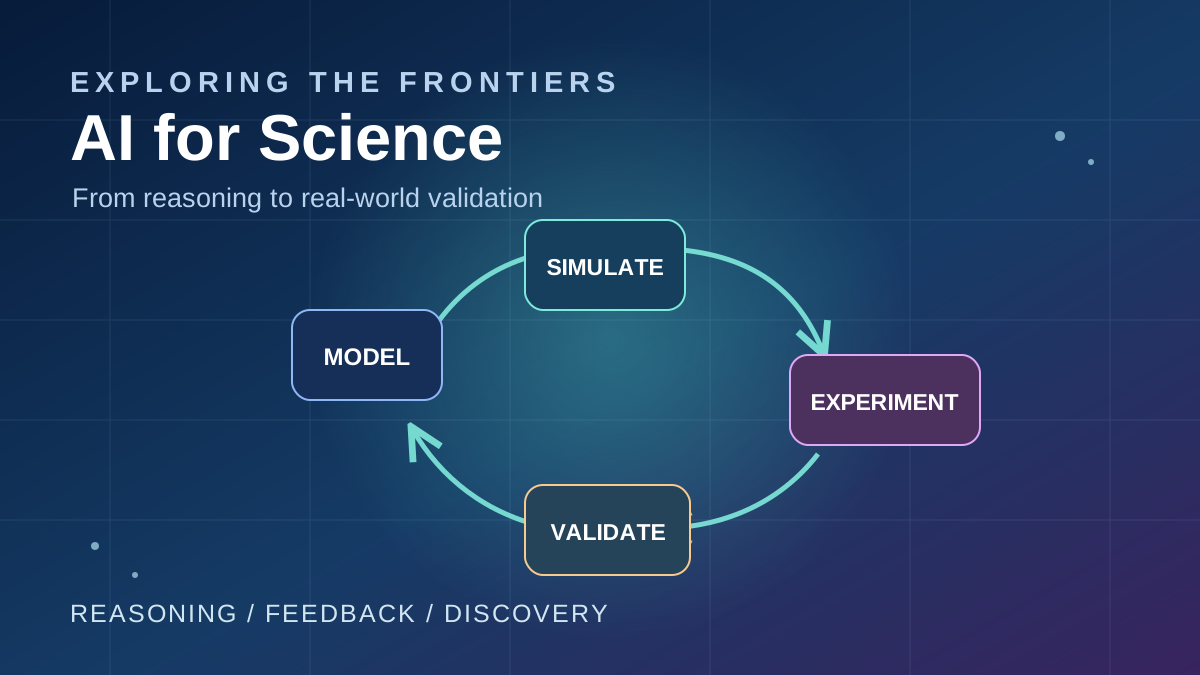
The trajectory of AI4S can be summarized by an integrated four-pillar loop:
\[\mathbf{Model} \iff \mathbf{Simulation} \iff \mathbf{Experiment} \iff \mathbf{Validation}\]- Models provide the high-level reasoning and rapid hypothesis generation.
- Simulations (and traditional numerical solvers) provide deterministic computational grounding.
- Experiments and Sensors (enhanced by automated laboratories and high-density 3D spatial data assimilation) provide real-world grounding.
- Validation frameworks close the loop.
The ultimate competitive edge in next-generation scientific AI will not just belong to whoever has the biggest model, but to whoever can build high-bandwidth, automated scientific feedback and validation systems that match the lightning-fast inference speed of modern AI.